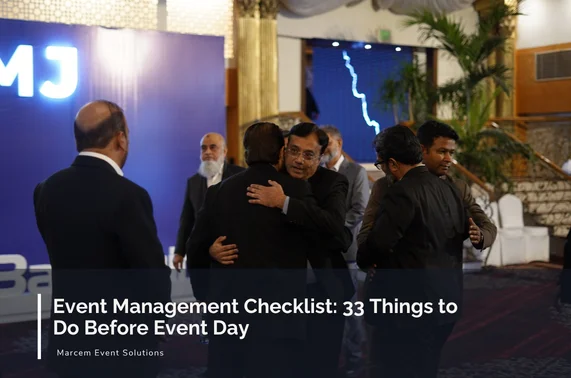
Event management is not something you figure out on the morning of your event. Behind every smooth, memorable occasion — a grand wedding in Karachi, a high-profile corporate conference, or a luxury private celebration — is weeks of meticulous planning, precise event coordination services, and expert execution.
This complete event planning checklist — 33 items organized across four phases — is the same system our best event planners use on every project. Use it to plan your own event, or share it with your event management company to ensure everyone is aligned.
| Phase | Timeline | Items |
| Phase 1 — Foundation | 3 to 6 Months Before | Items 1 to 8 |
| Phase 2 — Vendors & Creative | 1 to 3 Months Before | Items 9 to 18 |
| Phase 3 — Confirmation | 2 to 4 Weeks Before | Items 19 to 26 |
| Phase 4 — Final Checks | 48 to 72 Hours Before | Items 27 to 33 |
Phase 1: 3 to 6 Months Before the Event
Foundation & Strategic Planning — Items 1 to 8
The foundation of great event management in Karachi — and across Pakistan — is laid months before anyone sees the venue. This phase is about defining the vision, locking in the budget, and securing the most time-sensitive resources.
1. Define Your Event Objective and Type
Start with WHY. Nature of your event (Mehndi, Barat, Walima — wedding; corporate conference; product launch; private celebration) Your event type dictates what every decision that comes next looks like — which venue, how many heads to count, what style of decor makes sense, or caterer and when. No event management system ever reaches a destination with mediocre service only.
2. Set a Realistic Event Budget
A structured budget is a core part of any successful event planning checklist and ensures smooth event management solutions without financial surprises. break your total budget into clear categories: venue, catering, event design and decor, entertainment, audio-visual, logistics, photography, and a 10 to 15 percent contingency reserve. Detailed budgeting at this stage prevents the overspending that derails most self-planned events.
Real Cost Insight from 100+ Events — MARCEM
In self-managed events, the single biggest problem we encounter are budget overruns. Having managed more than 100 events in Karachi, our data remains consistent: last minute requirements — be it emergency lighting upgrades, vendor replacements, extra seating or additional security — always outstrip original estimates by 12 to 20 percent. Set aside at least 15% contingency from the get go. The missing step is the ones that are calling us in a frenzy two days before their event.
3. Select and Confirm Your Event Date
Look for conflicts — national holidays, major religious dates, other high-profile events in the city. Peak season for wedding events in Karachi stretches from October to February. Then for Karachi corporate event arrangements do not select periods with lower attendance like quarter-end or so. Sign your date in early — popular venues go quickly.
4. Estimate Your Guest Count
Your guest list will dictate your venue choice, catering levels and seating plans and transport logistics. Now just make a working estimate — you will refine it later. Changing the guest count just before an event sets much more complicated logistics for its planning.
5. Research and Shortlist Venues
Try at least three venues before signing. Examine capacity, location and accessibility, parking, back-up power supply, quality of in-house catering and equipment (AV) infrastructure, and decor flexibility. Premium venues like PC Hotel Karachi are ideal for luxury event management and large-scale functions, offering flexibility for high-end event setup services.
6. Book and Confirm Your Venue in Writing
Once you have your venue, try to get a date down on paper as soon as possible and pay your deposit. Avoid verbal agreements. Due to high demands, availability booking of two top event venues in Pakistan can be arranged as early as 4–6 months prior; Valid confirmation is only through mail.
7. Hire a Professional Event Management Company
This will be the most important decision you make. An experienced event management company has a ready-made network of vendors, tried and tested methods for executing the event, on-the-day crisis management, and creative direction that no in-house team can match. Research the best event management company options in Karachi, check out portfolios, talk to previous clients, and verify exactly who will be managing your event.
How to Evaluate an Event Management Company, What to Actually Ask
Most questions are wrong when clients try to hire an event management company. Avoid asking: How many events have you done? — Ask, ‘Have you done an event at my particular venue? and ‘Can I talk to somebody from your last three events?’ For instance, a company that has organized events at PC Hotel Karachi already knows how much of the venue’s power load can be handled, how far it is from kitchen to station and where their ceiling rig points are as well as have preferences for staff contacts. Just on event day alone, that institutional understanding saves 6 to 8 hours of coordination.
8. Define Internal Roles and Responsibilities
Identify who on your side is the primary contact, who manages vendor payments, who handles guest communications, and who is present on event day. Clear roles eliminate confusion and ensure your event management company has the right contact for every decision
Phase 2: 1 to 3 Months Before the Event
Vendor Booking & Creative Planning — Items 9 to 18
This is the most intensive phase of event management. Every major vendor must be confirmed, every creative decision locked in, and the full event production services plan must be in place. The best event management companies in Pakistan treat this phase with the same rigour as the event day itself.
9. Book and Sign All Vendor Contracts
Strong event vendor management ensures all vendors perform according to expectations without delays or miscommunication. Caterers, decorators, photographers, videographers, entertainers, AV companies, florists, and transport providers — every vendor must have a signed contract with clear deliverables, payment schedule, cancellation terms, and backup provisions. Professional event vendor management means nothing is left to verbal agreement.
10. Finalize Your Event Theme and Design Direction
Your theme defines every visual element and plays a key role in event design and decor, ensuring a consistent and premium experience. Identify a strong theme so your guests can enjoy a cohesive experience. Enlist your decorator by providing him or her with a so detailed design brief and mood board that he or she must look it up before signing off on anything.
11. Plan the Catering Menu in Detail
Efficient catering flow is a critical part of event logistics planning, especially for large-scale events in Pakistan. Collaborate with your caterer to solidify the entire menu. Think about your guest demographic — dietary restrictions, cultural preferences and age range. For bigger gatherings, schedule how many food stations to have where. Organizers of such events always carry out catering function flow planning, so that they never have to wait in long lines at peak serving hours.
The 6-Station Rule — Learned from a 500-Guest Event Gone Wrong
During the early days of our event management journey, we did a corporate dinner for 500 guests with just 4 catering stalls. By 8:30 PM, lines wove through the whole hall. Guests grumbled, the host became embarrassed, and the caterer was blamed — but it was actually a failure to plan event logistics. In the years since that event, our baseline for any reception with more than 300 guests is a minimum of 6 to 8 stations distributed throughout the entire floor plan and dedicated serving staff at every station. Since then, we have not had any complaint about our catering flow.
12. Approve Stage and Decor Design
Submit your entire decor brief to your decorator — size of stage, backdrop design, setup for the entrance and table centerpieces, flowers and lighting requirements. Before signing off on this, ask for a visual mockup/3D render. Last-minute decorations are costly and upend everything.
13. Confirm Photography and Videography Coverage
Book seasoned professionals who know how to shoot your venue. Supply a comprehensive shot list of what your photography hopes to capture, covering major moments, family groupings, candid coverage and any must-do shots. Proper logging helps to avoid losing shots that can never be replicated.
14. Plan Audio-Visual and Event Production Services
For the corporate functions: projectors, LED screen, presentation systems, lapel and handheld microphones. Weddings: Full DJ / Speaker setup, live band equipment. Double-check all technical needs — power load, cable run, rigging points — with your venue long before setup day.
15. Send Formal Invitations with RSVP System
Ideally, you want your invitations to go out 6 to 8 weeks in advance. Date, time, name of venue with Google Maps link (but it won’t just say “venue” dress code to follow, RSVP date and special instructions For large events, an electronic RSVP tool will help you keep track of confirmations accurately (analogue tracking falls down at 150 guests).
16. Arrange Guest Accommodation and Transport
Book a block of hotel rooms at nearby hotels for out-of-town guests. You are going able to organize VIP transportation. For larger events, provide shuttle transportation to key pick-up points. With inspired planning that takes care of all logistics for shuttling guests to and from the venue, event hosting services rank pretty high on satisfaction.
17. Handle Permits and Compliance Requirements
Depending on your event type and location, you may need sound permits, food safety approvals, crowd management NOCs, or venue-specific documentation. Experienced event organizers in Pakistan know exactly which permits apply to which event types — this is one area where professional event management companies add immediate value.
18. Build a Detailed Event Run-of-Show
A run-of-show is a minute-by-minute timeline of every event day activity — guest arrival, program start, speeches, entertainment, food service, and departure. This document is the backbone of your event execution strategy and should be shared with all vendors. and team member at least two weeks before the event.
Phase 3: 2 to 4 Weeks Before the Event
Confirmation & Coordination — Items 19 to 26
This a phase where you tighten every single detail. Every vendor re-confirmed, venue walk-through complete, and that full event coordination checklist is reviewed. Pakistani professional event planning experts consider this time frame as the last available chance to get everything right before you hit the actual day of the event.
19. Confirm Final Guest Count and Update All Vendors
Finalize your RSVP count and immediately share the updated number with your caterer, venue, decorator, and seating coordinator. Adjustments made now are manageable — changes made two days before the event cause significant disruption and cost.
20. Conduct a Full Venue Walk-Through with All Key Vendors
This step is essential in any professional event coordination checklist used by top planners. Take your event management team, decorator and AV vendor together to the venue. Make a walk-through of each area — entrance ways, the stage, food stations, guest flow corridors, bathrooms emergency exits and parking. Spot all logistical issues as early possible and solve them.
Our 3-Point Walk-Through Protocol — Built from On-Day Failures
After running venue walk-throughs for hundreds of events across Karachi, we have a strict 3-point protocol our team checks before anything else. First: power outlet locations and total load capacity — we once had a lighting rig trip the main breaker 40 minutes before a Walima because nobody had checked the panel. Second: ceiling height for hanging decor and lighting rigs — custom chandeliers require specific clearance. Third: kitchen-to-station distance — every 10 meters adds 3 to 4 minutes to service time at peak load. These three details cause more on-day crises than everything else combined.
21. Create and Share Vendor Arrival Schedule
Specify exactly when each vendor arrives for setup — decorator, AV team, caterer, florist, photographer. Build buffer time between each vendor arrival to avoid access conflicts. Distribute the schedule in writing to every vendor and your internal team.
22. Finalize and Print Seating Arrangement
Create the Final Seating Plan from Confirmed RSVPs Consider family groupings, VIP placement, blind spots for elderly guests and sight lines to the stage. Proper seating planning is a key part of event scheduling planning and guest experience.
23. Prepare Your Event Day Emergency Kit
Pack a dedicated kit: tape, scissors, safety pins, stain remover, basic first aid supplies, phone chargers, printed vendor contact list, extra invitations, pens, a small cash reserve, and spare printed materials. This kit has resolved more on-day crises than any other single preparation.
24. Brief Your Full Team and On-Day Volunteers
Clear communication is what separates average planners from a professional event planner team. Have a formal briefing session to get everyone who’s involved in running the event — internal team members, venue stuff and volunteers. Include run-of-show, individual responsibilities, escalation protocol and emergency procedures. Before the big day, every person in the room should know their role.
25. Reconfirm Entertainment and Program Schedule
Contact every single one of the performers, emcees, speakers and entertainers. Check arrival time, technical requirements and timing in the program slot — as well as any last-minute changes. Share your final event scheduling and planning doc with each of them.
26. Clear All Vendor Payments and Balances
Review all the contracts and settle any payments due on time. Many vendors also require final settlement 7 to 10 days in advance of the event. Late payments can affect vendor motivation and performance — and this one is a must-have in any corporate event planning package to ensure nothing goes south.
Phase 4: 48 to 72 Hours Before the Event
Final Checks — Items 27 to 33
The final 48 to 72 hours before an event define the reputation of every event management company. This is where planning meets execution — where every confirmation, every detail check, and every prepared contingency comes together.
27. Final Confirmation Call with Every Key Vendor
Call or text every essential vendor — caterer, decorator, A.V. team, photographer, videographer and transportation provider. Ensure they’re on track, know the correct address and have your direct number for the event manager. This single call has saved the day from a previously judgment-filled evening of no- shows and last-minute surprises in our experience as event-hosts in Pakistan.
28. Print All Physical Event Materials
Print all signage, guest name cards, table numbers, menus, programs, directional signs, and seating charts. Proofread every item carefully. There is no time to reprint on event day — errors discovered in the morning stay for the entire event.
The 15% Print Rule — Why We Learned This the Hard Way
At a 350-guest corporate awards night early in our event management career, we printed exactly 350 name cards. By 7 PM, 23 additional guests had arrived with valid invitations — last-minute additions the client had not communicated. We spent 40 minutes handwriting emergency name cards at the registration desk. The client noticed. The guests noticed. Now our standard on every event is a mandatory 15% print buffer on all guest-facing materials — name cards, menus, programs, seating charts. It is a small cost that protects a large impression.
29. Send Final Guest Communication
Send a last reminder to all confirmed guests — venue address with Google Maps link, parking instructions, event start time, dress code reminder, and any important day-of information. For large events, a WhatsApp broadcast message is the most effective delivery method in Pakistan.
30. Inspect the Venue During Setup
This step ensures your event management services are executed exactly as planned. Arrive at the venue while setup is happening — typically, 18 to 24 hours before doors open. You’re checking that decor is going up on-time, that lighting is rigged in the right places, that catering stations are arranged as per approved layout and your venue team is aware of your run-of-show. Diagnose issues at this time, not when something happens.
31. Test All Audio-Visual Equipment
Conduct a complete AV testing is a critical part of event production services and prevents major on-day failures. Test every input, every camera angle if applicable, and every microphone position. Identify and resolve every technical issue before the first guest arrives. AV failures during live events are the most visible and most preventable problems in professional event production services.
32. Set Up Your On-Day Communication System
Strong communication systems are essential for efficient event coordination services. Be sure to establish a reliable tested communication system for your whole event team — private WhatsApp group, walkies for larger venues or shared operations apps. Give each team member printed copies of the emergency contact list and final run-of-show. The most significant differentiator between an amateur and professional event coordination service is, communication.
33. Rest Before Event Day
This one will be the most overlooked thing on every professional event planning checklist. Event professionals tired tend to commit mistakes. A fatigued team endlessly misses cues and takes a most torturous length of time in response to issues. Set everyone up to succeed: Give your key players the night off. On the event day show up sharp, cool and collected and ready to deliver the experience that your client requires.
Why Work With a Professional Event Management Company?
Professional companies offer complete event management packages, combining planning, execution, and on-day coordination under one system. Managing 33 separate tasks across multiple months, coordinating a dozen vendors, and executing flawlessly on event day is not something most people — or most in-house teams — can do alone. And it should not have to be.
The best event management companies in Karachi and across Pakistan bring:
- Pre-built vendor relationships: faster bookings, better rates, and direct accountability
- Proven event execution strategies: developed from hundreds of real events across Pakistan
- On-day crisis management: solving problems before guests ever notice them
- Professional event design and decor expertise: transforming venues into unforgettable spaces
- A single point of coordination: eliminating the stress of managing multiple vendors yourself
MARCEM Event Solutions provides end-to-end event management services throughout Karachi and Pakistan — from conceptualisation to venue selection, through on-day execution and post-event wrap-up. With our event planning group managing weddings, corporate meetings, product launches, shows and customized events at the top venues in town.
From complete wedding event planning in Pakistan, corporate event planning in Karachi or even just a trusted event organizer for a small private celebration, MARCEM Event Solutions has the experience, team and systems to be able to deliver to you.
Frequently Asked Questions About Event Management
Q1: How early should I start planning my event?
Weddings: at least 4 to 6 months in advance. Corporate events: minimum 2 to 3 months. The earlier you start, the better your venue and vendor options.
Q2: What does an event management company actually handle?
Everything — venue selection, vendor booking, budget management, decor, logistics, on-day coordination, and post-event wrap-up. One company, full accountability.
Q3: How do I choose the best event management company in Karachi?
Check their portfolio, ask for client references, and confirm they have experience at your venue. Always meet the actual team who will manage your event — not just the sales person.
Q4: What is the most common mistake in event planning?
Starting too late. Venue unavailability, vendor conflicts, and budget overruns almost always happen because planning began too close to the event date.
Q5: What event management services does MARCEM offer in Karachi and Pakistan?
Full-scope services — weddings, corporate events, event setup, production, decor, and on-day coordination across Karachi and Pakistan. Contact us for a free consultation.
Plan Your Event with MARCEM (Karachi & Pakistan)
This 33-point event planning checklist is the same framework used by our professional event planners on every event we manage. But having the checklist is just the beginning — executing it successfully across 3 to 6 months of preparation, with dozens of vendors and hundreds of moving parts, is where expert event management in Pakistan makes all the difference.
Do not plan your most important event alone. Let Karachi’s trusted event management company handle every detail — from venue selection to the final moment of event day — while you focus on enjoying the experience.
Contact MARCEM Event Solutions Today:
- Phone: +92 300 8280182
- Email: [email protected]
- Website: https://marcem.com.pk